Electrical work in Austin ranges from swapping a worn-out outlet to a full service panel upgrade, and the difference in cost and complexity is enormous. This guide covers the electricians listed in the HomeImproverz directory for Austin and the surrounding communities of Round Rock, Pflugerville and Cedar Park, along with typical installed-cost ranges for the most common jobs. You will also find what usually needs a permit, the warning signs that should prompt a call, and the questions worth asking before anyone opens up your walls. The listings here include 27 electricians, 12 of which list a license and 10 of which advertise 24-hour availability for emergencies.
- 27 listed pros
- Average Google rating 4.7
- 10 list 24-hour availability
- 12 list a license number
What electricians do
Licensed electricians handle the wiring, panels and devices that keep a house safe and running. In the Austin area, the work homeowners ask about most often falls into a handful of categories. Panel upgrades move a home from an older service to a higher amperage so it can carry modern loads. Wiring and rewiring covers new circuits, adding outlets, and replacing aging or damaged wire inside walls. Lighting installation includes fixtures, recessed lighting and outdoor lighting on existing or new circuits. EV charger installation adds a Level 2 circuit in the garage or carport. Generator installation brings in a standby unit with a transfer switch, gas line and pad. Emergency electrical service covers partial outages, burning smells, tripped main breakers and other problems that cannot wait for a weekday appointment. Because much of the housing stock around Austin spans many decades, an electrician may find a mix of updated and original wiring in the same home, which changes both the scope of the job and how long it takes. Ten of the listed electricians advertise 24-hour availability, which matters if a problem shows up at night or on a weekend. Five are veteran-owned and four are women-owned businesses.
Signs you need a electrician
- Breakers trip repeatedly or the main breaker will not reset.
- Outlets or switch plates feel warm, or you smell something burning near them.
- You rely on extension cords or power strips because rooms lack enough outlets.
- Lights flicker or dim when an appliance starts up.
- The panel is an older model with no room for additional breakers.
- You are planning a Level 2 EV charger, a hot tub or a major appliance addition.
- You are buying or renovating a home and the wiring history is unknown.
Electrical costs
The figures below are typical national installed-cost ranges, and they vary with the condition of your home, access to the work area and the contractor you choose. An electrical panel upgrade runs $1,500 to $4,500 per job, driven by amperage changes such as 100A to 200A, utility service changes, and permit and inspection costs. Level 2 EV charger installation runs $800 to $2,500 per job, depending on distance from the panel, panel capacity and the charger hardware itself. Whole-house generator installation runs $7,000 to $20,000 per job, with generator size, transfer switch, and gas line and concrete pad among the cost drivers. Whole-house rewiring runs $6,000 to $20,000 per job, driven by home size, wall access and whether the panel is replaced at the same time. Ask each electrician for a written scope so you can compare like for like.
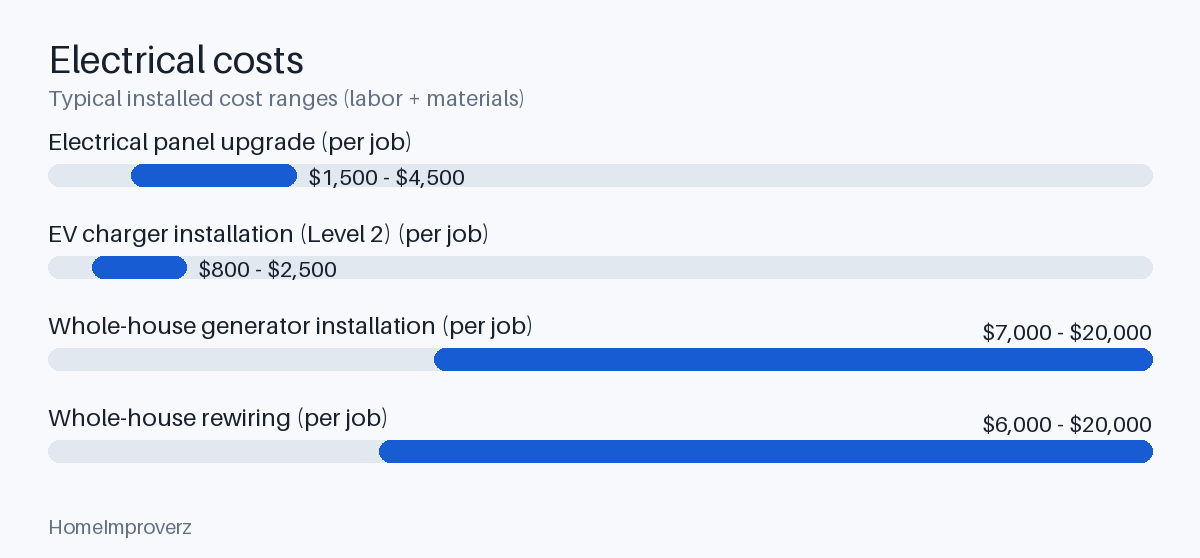
| Project | Typical range | Main cost drivers |
|---|---|---|
| Electrical panel upgrade | $1,500–$4,500 per job | amperage (100A to 200A), utility service changes, permit and inspection |
| EV charger installation (Level 2) | $800–$2,500 per job | distance from the panel, panel capacity, charger hardware |
| Whole-house generator installation | $7,000–$20,000 per job | generator size, transfer switch, gas line and concrete pad |
| Whole-house rewiring | $6,000–$20,000 per job | home size, wall access, panel replacement |
Typical installed-cost ranges, labor and materials included. Your price depends on your home and the contractor – get two or three written estimates. Ranges are periodically reviewed.
Permits
Permits are usually required for panel upgrades, new circuits, EV charger circuits, generator installation and rewiring. Small replacements, such as swapping a light fixture or an outlet on an existing circuit, usually do not need one. Permit rules are set by your city or county building department, and many require the licensed contractor to pull the permit and schedule inspections. Confirm who is filing before work starts.
Usually needs a permit
- Panel upgrades
- New circuits
- Ev charger circuits
- Generator installation
- Rewiring
Usually doesn’t
- Replacing a light fixture or outlet on an existing circuit
Permit rules are set by your city or county building department, and many require the licensed contractor to pull the permit and schedule inspections.
Hiring checklist
- Confirm the electrician is licensed and ask for the license number in writing.
- Request a written estimate that lists materials, labor and what is excluded.
- Ask who will pull the permit and who meets the inspector on site.
- Check that the company carries insurance and ask for a certificate.
- Ask whether the crew doing the work is employed or subcontracted.
- Get a timeline in writing, including how long the power will be shut off.
- Confirm how the contractor handles drywall patching after wiring work.
- Ask what warranty covers the work and how long it lasts.
Frequently asked questions
How do I compare electricians in Austin when quotes differ a lot?
Ask each one to describe the same job in the same terms: what circuits or panel work is included, what materials are specified, whether the permit is in the price and whether drywall repair is included. A wide gap usually means one quote is missing scope rather than one contractor being unusually expensive. Compare the written scopes side by side before you compare the totals.
Do I need a permit to replace an outlet or light fixture?
Usually not, if you are simply replacing a fixture or outlet on an existing circuit. New circuits, panel upgrades, EV charger circuits, generator installation and rewiring generally do require a permit. Your city or county building department sets the rule, and many require the licensed contractor to pull the permit and schedule the inspection, so confirm this before work begins.
What does a panel upgrade cost and why does the price vary?
Typical installed-cost ranges run from $1,500 to $4,500 per job. The spread comes from amperage changes such as moving from 100A to 200A, any utility service changes needed, and permit and inspection costs. Your actual figure depends on the condition of your existing service, how accessible the panel is and the contractor's scope, so treat the range as a starting point for conversations.
Can any electrician install an EV charger, or is it a specialty?
Level 2 charger installation is a circuit installation job, so look for an electrician who has done them before and can talk through panel capacity and the run from the panel to the parking spot. Typical installed-cost ranges are $800 to $2,500 per job, driven by distance from the panel, available capacity and the charger hardware you choose.
How do I find an electrician at night or on a weekend?
Ten of the electricians listed for the Austin area advertise 24-hour availability, which is useful for partial outages, a main breaker that will not reset or a burning smell near an outlet. Even for emergency calls, ask for the license number and a written estimate, and ask whether after-hours rates differ from standard rates before anyone starts work.
How long does whole-house rewiring take?
There is no single answer, because the timeline depends on home size, how much wall access the electrician has and whether the panel is replaced at the same time. Typical installed-cost ranges for whole-house rewiring are $6,000 to $20,000 per job, and the lower end usually reflects easier access and less extensive work. Ask each contractor for a written schedule with the estimate.
Cost guides
Nearby cities
Explore more
Find electricians near you
Browse local pros by city, compare ratings and hours, and request written estimates.
Last updated November 16, 2026

Congratulation!